This page contains Amazon affiliate links. As an Amazon Associate, we earn from qualifying purchases – the price doesn't change for you. Learn more
The Watt-Hour Limit That Really Matters
It’s not the mAh number on the packaging that’s crucial for the airline, but the watt-hour (Wh) number. You can take a power bank with up to 100 Wh without prior approval from the airline. Between 100 and 160 Wh, you need prior approval. Anything above that is generally prohibited, regardless of the checked baggage.
Converting mAh to Watt-Hours: Here’s How
The casing almost always only shows the mAh number, not the watt-hours – you have to calculate that yourself. The formula is: Wh = (Nominal voltage in V × Capacity in mAh) ÷ 1000. The nominal voltage for most power bank cells is 3.7 volts.
A calculation example with the Anker Power Bank 20,000 mAh, 87 W: 3.7 V × 20,000 mAh ÷ 1000 results in approximately 74 Wh – well below the 100 Wh limit and therefore suitable for flying without consulting the airline. If you’re unsure, you’ll often find the exact watt-hour rating printed in small letters on the back of the power bank. The Anker Power Bank offers a capacity of 20,000 mAh and a total power of 87 W (65 W via USB-C, 22 W via USB-A). An integrated USB-C cable provides additional flexibility.
Carry-On Luggage Only, Never Checked Baggage
Power banks belong exclusively in carry-on luggage. This rule applies regardless of capacity and is now being specifically checked at many security controls. The reason is the same as for other lithium batteries: In the cargo hold, a possible cell fire can be much more difficult to detect and extinguish in an emergency than in the cabin.
What Changed Since March 27, 2026
Since that date, a stricter regulation applies for all 193 ICAO member states: power banks are no longer allowed to be charged during the flight via USB ports or power outlets at the seat. Some airlines are now going even further and generally prohibiting the charging of smartphones or tablets via a carried power bank during the flight. These additional restrictions are currently still defined by each airline – so it’s worth checking the terms and conditions in addition to the ICAO basic rules.
Just Before Takeoff: The Checklist
Calculate the watt-hour number beforehand or check it on the power bank, store the power bank exclusively in carry-on luggage, and check directly with the respective airline to see if there are any restrictions beyond the ICAO basic rules – especially with non-EU airlines, this can sometimes differ noticeably.
Our Assessment
For most travelers, practically nothing changes: A power bank with a common capacity of 10,000 to 20,000 mAh is with around 37 to 74 Wh safely below the 100 Wh limit and can continue to be taken on board without any problems. Those who fly regularly should still familiarize themselves with the new rule regarding charging during the flight – it is now noticeably more consistently enforced on board than it was a year ago.
Products mentioned in this post
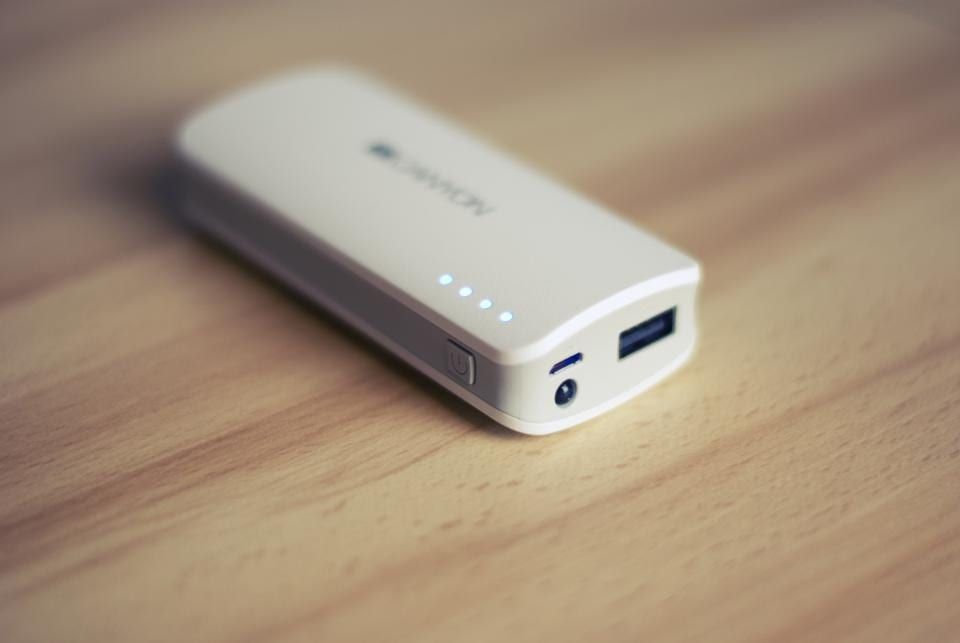
Anker Powerbank 20,000 mAh, 87 W
Power bank with a permanently integrated USB-C cable and up to 65 W – enough for many laptops.
You might also like
All posts in this category
GaN Chargers: An Overview of the Benefits
GaN chargers are smaller and more efficient than traditional models. We explain what GaN means and who will benefit from the investment.
Learn more
Buy a Power Bank: How Much mAh Do You Need?
Buying a power bank: mAh, Watts, and charge cycles explained simply – so the capacity matches your usage habits. We'll give you tips for choosing the right power bank.
Learn more